It has become significantly easier to build an AI solution than it was just a few years ago. With strong language models, good development tools and access to code help, you can quickly get from idea to prototype.
This is also why many organizations have already seen examples of AI solutions that look promising in demo format. An internal prototype can often be built surprisingly quickly.
But there is a big difference between a prototype and a solution that you can actually use in operation.
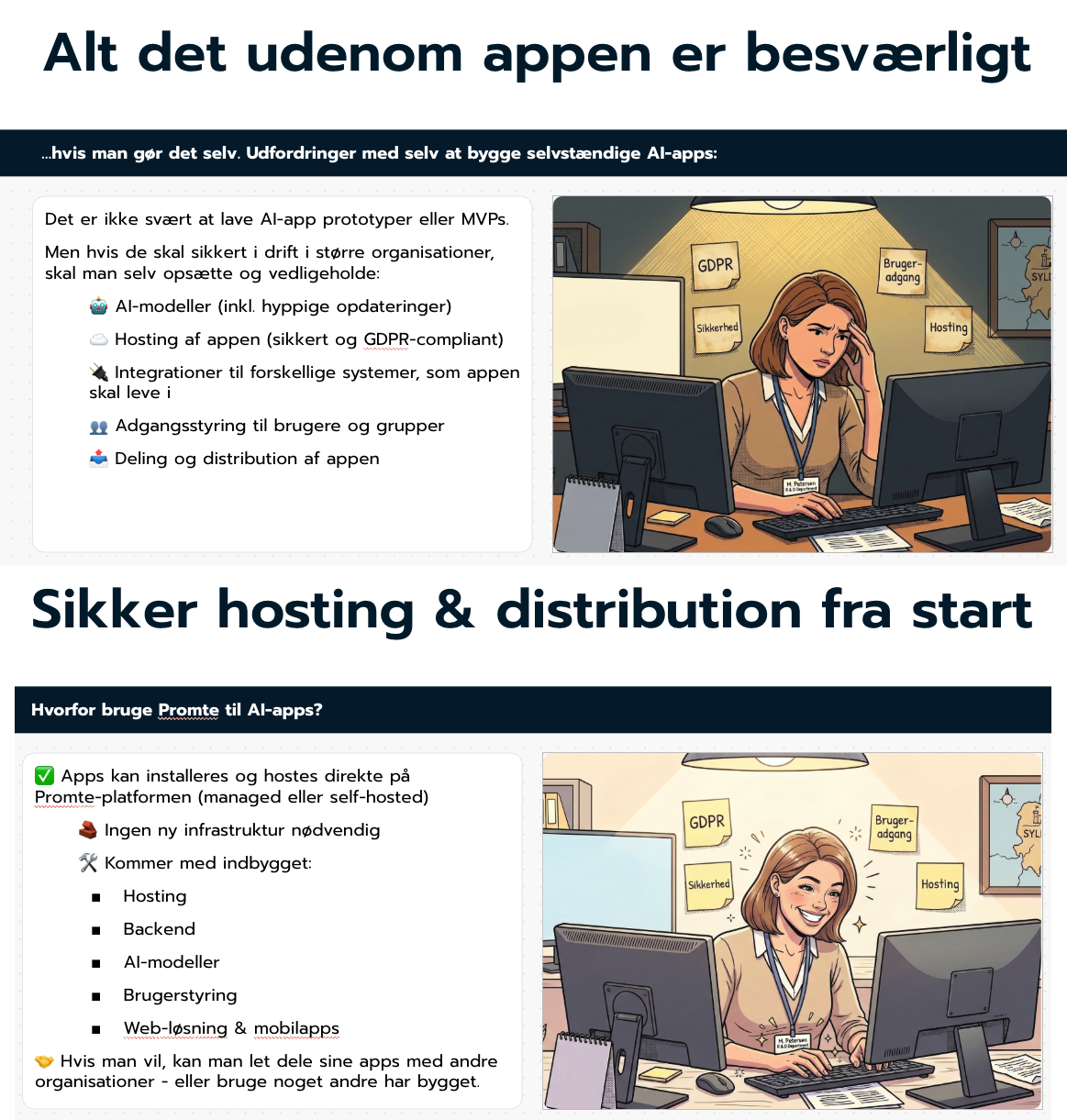
That was one of the main points in our webinar on AI apps at Promte: The app itself is rarely the hardest part. The hard part is all the extraneous stuff.
When showing an AI app for the first time, it is often the visible part that fills up. The user interface looks reasonable. The model provides an answer. The flow is connected. And then it can be tempting to think that you are almost there.
But in larger organisations, and especially in municipalities and the public sector, the real work often starts precisely there.
Because an AI app doesn't have to work just once. It must function stably. It must be usable by real employees. It must be able to handle access, updates and sharing. And it must fit into the organization's security and operational setup.
If those things are not thought out from the start, even a good prototype quickly becomes a heavy solution to carry forward.
An AI app rarely stands alone. It depends on the models that drive the functions behind it.
This means, among other things, that you have to decide which models to use, how to update them, and how to balance quality, price and speed. It is not a one-time decision. The model market is changing rapidly, and so are the requirements for performance and application.
If an organization builds and operates AI apps itself without a unified layer around the models, it quickly becomes a task in itself to keep the solution up to date. Every new version, every change in pricing structure, and every tweak in model behavior can have consequences for the app that sits on top of it.
It is not necessarily impossible. But it's a type of work that many people underestimate in the beginning.
For many AI projects, the next challenge arises as soon as the solution has to handle real data.
As long as you work with non-committal examples, everything seems simple. But as soon as the solution is to be used in a municipality or a larger organisation, the questions become more concrete: Where is the app hosted? How is data handled? Which safety requirements apply? How does the solution fit into the organization's existing setup?
In the public sector, it is rare enough that something just "can work". It must also be able to be explained, operated and anchored properly.
This means that hosting is not a technical detail. It is a central part of the solution. The same applies to the backend, logic around data handling and the framework the app is part of.
The earlier those questions are thought through, the easier it will be to get the solution from idea to real use.
An AI app must also live somewhere in the organization. Users must be able to log in. The right people must have access. The solution may need to be shared with specific teams or departments. In some cases, it must also be able to interoperate with other systems or workflows.
This is precisely where many otherwise promising AI projects become more difficult than expected.
Because even if the app itself is built quickly, someone still needs to ensure:
These are classic operating tasks. But they are often more crucial to the actual success than the first version of the user interface.
In the webinar, we described why Promte's approach to AI apps is precisely about making external work easier.
The point is not just that you can build an app. The point is that the app can be placed on top of an existing platform where key things are already in place: hosting, backend, models, user management and distribution via web and mobile.
This does not change the fact that you still have to think your solution through. But it moves much of the heavy foundation away from the individual project.
It is especially valuable in organizations where AI should not just be an experiment, but part of daily operations. Here, it is often more realistic to succeed when you build on top of something existing than when you start by establishing a separate stack for each new app.
When AI apps are discussed, innovation naturally looms large. But in practice, it is operation that determines whether an idea becomes useful.
A well-functioning AI app is not just a nice demo. It's a solution that employees can access, trust and use again tomorrow. And next month. And when it needs to be updated.
Therefore, it makes sense to think about operation from the start, even if it may feel less exciting than the prototype itself. This is precisely the part that makes the difference between something interesting and something useful.
If you work with AI apps and would like to avoid the operation becoming the bottleneck, it may be worth taking a closer look at how Promte provides hosting, models, user management and distribution as part of the platform.