One of the big challenges with AI in organizations is not just building something that works. It is to make the solution easy to use, easy to maintain and easy to share with others.
That was the background for an important part of the launch in our webinar on AI apps at Promte. Here we not only showed that you can build AI apps on the platform. We also showed how apps can be installed, shared and moved between organizations through an app library.
This is an important difference. Because when AI solutions become shareable, their value increases significantly.
In the webinar, we presented two things which are closely related.
One part is a framework for building AI apps on Promte. Here, organizations can develop their own apps with the user interfaces and functions they need, while building on top of Promte's existing layer for, among other things, hosting, backend, models and user management.
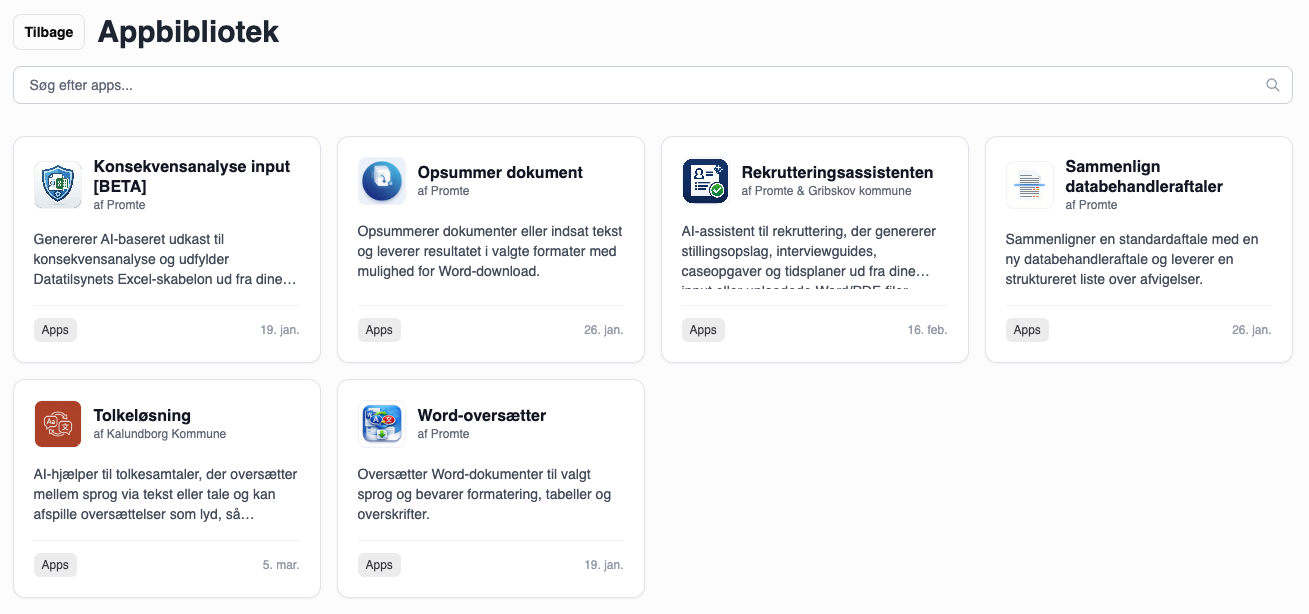
The second part is an app library with pre-built apps that can already be installed and used. Here, among other things, the recruitment assistant, impact analysis draft, a Word translator and the interpreter app from Kalundborg Municipality were mentioned.
The two parts reinforce each other. The framework makes it possible to build. The library makes it possible to use and share.
In many organizations the same needs arise at roughly the same time.
A municipality would like to automate the first draft of citizen letters. Another would like to streamline the work with translations. A third needs help with document-heavy assessments or internal notes. The needs are not identical, but they are often similar enough that you can learn from what others have already built.
This is exactly where an app library makes sense.
Instead of each organization having to start from scratch, you can start from existing apps. Some solutions can be installed directly. Others can be used as inspiration or further developed for local needs.
It not only saves development time. It also creates a more mature ecosystem around AI apps, where good ideas don't stay in silos.
In the webinar, we also showed the practical part: that an app can be installed directly from the library into the organisation's own Promte setup.
It may sound like a small thing, but it is crucial in practice. Because an app only has value when it actually reaches users.
When installation and distribution are part of the platform, the path from "this looks interesting" to "my colleagues can use this" becomes shorter. It also makes it easier to work with updates, because apps do not have to be handled as separate individual projects without a common home.
At the same time, this means that sharing is not only theoretical. If an organization chooses to do so, its app can become available to others in a way that is far more concrete than a loosely described idea in a meeting or in a PDF.
Another important point from the webinar was that Promte also provides examples and packages so that organizations don't have to invent everything themselves.
This applies to both open source examples and the tools that make it easier to call functions and work with the app logic. This type of material is often underestimated, but it is very important in the early stages. Many get started faster when they can see a real solution and not just read a theoretical description.
It is especially useful for organizations that can develop themselves, but do not want to spend unnecessary time building the same basic elements over and over again.
Shareability is therefore not only about sharing finished apps. It is also about sharing building blocks.
When talking about AI in municipalities and larger organisations, it can quickly sound as if each solution must be a large special project. But much of the value actually arises when small and medium-sized solutions can be reused, adapted and taken forward.
An app library supports just that kind of adoption. It makes it possible to start smaller, learn faster and build on what already works.
It is also a more realistic model for organizations that want to create momentum without starting a new development process for each and every idea.
If another organization has already solved 70 percent of the task, it often makes more sense to build on from there than to start over.
Perhaps the most important point is that sharing makes AI more useful as a shared capability.
When apps can be installed, customized and shared across, AI doesn't just become something that lives in individual experiments. It will be something that more people can benefit from, without each organization having to bear the entire burden alone.
It fits well with the reality that many municipalities find themselves in. There is both a need for local adaptation and for solutions that do not need to be invented from scratch every time.
That's why we see the app library as more than a collection of apps. It's a way to make AI work more practical, more mature and more shareable.
If you want to get started quickly, it may make sense to start with the apps that are already ready. And if you have a process that is better suited to a custom-built solution, it is possible to build your own app and share it further, if that makes sense.